
The Zonker.... "When I was a child and got out of line my father would smack me on the head. When I read the newspaper as an adult I realize that some people and most politicians need a good zonk! Alas, another site dedicated to politics, economics, morality and culture."...... "Almost all lies are acts, and speech has no part in them." Mark Twain
Friday, June 26, 2009
Get a Job
Since my 12th birthday I have never been without a job more than a couple weeks with one exception, when I became homeless because I could not land a job for over a year. In retrospect I had allowed my worries and anxieties to block me from obtaining even a reasonable position to meet the basic needs of food and shelter. I now have one of the best positions I ever could have secured given my lack of a college degree or confidence to run my own business. Because I know the realities of not knowing where my next meal would come from, let alone where I might spend the night, I am compelled to offer my insight into the complexities of job hunting to those who are currently having trouble finding suitable employment.
There are a number of issues that need to be addressed when one dives into the labor pool. First, let’s just list the items of concern, and then we will address each individually.
1. The resume
2. Job History
3. The Interview
4. Body, Mind and Spirit
5. Attitude
6. Resources and Networking
7. Creativity
8. Starting Over
The Resume
When you put your resume together, keep in mind that the person reviewing it may be looking at anywhere from a few dozen in a small business, to thousands in a large business. It should therefore be short, clear and concise, not more than two pages. Keep the type simple and clear and use basic font size, italics and bold as your pallet. Do not use fancy graphics or font, bullets or boxes to enhance the information. The reviewer is only interested in whether you meet the qualifications for the position, and have a professional attitude. Avoid specialty colored paper and envelopes. Unless you’re applying for a position to the Queens Court, or perhaps a Graphic Designers position at Hallmark, then there is rarely a need to be excessively expressive. Reserve that type of attention for a follow up thank you note, which I will explain later.
A good resume provides no more than five areas of information. First is your personal information such as your name, address, and contact information like phone number or email.
Then you need to state clearly what position you’re applying for or objective. Next a summary of accomplishments that makes you uniquely qualified for that specific position. This is where you brag about your credentials. List any degrees or certifications you may have as well as projects you completed. I would sometimes list 3 to 5 bullets of highlighted items from the job description in the context of my experience. For example: If the job requires a working knowledge of specific equipment operation I would list those of which I had experience and knowledge, or if it required experience in specific software I would list all the programs I was proficient in and note those I was knowledgeable in. Following that I would place a few bulleted items of significant achievements. Here I noted how I was an asset to my past employers by setting and exceeding a certain goal or taking on an issue outside my normal job function to enhance the efficiency of the business. Further, if the position request a self motivated individual I would illustrate a couple of my extracurricular activities, like teaching myself HTML or learning Spanish. Just make sure it applies to the duties and responsibilities of the position you’re applying to fulfill.
The next block of information on the resume should be the job history. Here you want to provide as much information as possible, and it depends on how many positions you have held in the past. Typically, you do not want to list more than the past ten years of employment. Provide full company name, address and correct zip codes. If the HR department cannot verify your employment history you will most likely be passed up for the position regardless if you’re qualified. Make sure phone numbers are still active or that the business is still located in the same place when you worked there. Sometimes it is still the same business and staff, but they brand a new name and currently answer the phone differently. Place the new name on the resume, not the one you worked under. List the employment period to the nearest month and year, exact days if possible, but make it consistent for all employers listed. In other words, do not use dd/mm/yy for one employer, then mm/yyyy for the next. If you had periods of unemployment over a month, explain them. If your periods of unemployment are under a month, list using the mm/yyyy format will hide the lapses. In today’s shifting economy employers are not so concerned about brief periods of unemployment; they are concerned about long periods of unemployment. Do not lie in the job history or exaggerate your position. Be truthful. Honesty and integrity carry more weight than failure. An employer can work with someone that is not afraid to say I made some mistakes, than someone that is a know it all.
Finally, the last part of the resume should breakdown your education, any clubs, organizations, or volunteerism pertinent to the position, and military service and experience if it has a positive effect as a potential candidate.
If you cannot fit all that information on one page legibly then do not try to cram it all in by reducing the font down to a size that strains the readers eyes, just place it on two pages in a plane clear font of reasonable size. Spacing should be utilized to make it comfortable to read. Try to keep blocks of information together and avoid breaking blocks across page breaks.
Job History
Sometimes I had to take a job that was out of my career of choice. The market and your area of residence will have more an influence on what your choices are than your ability. When you are drawing unemployment benefits, they sometimes send you on an interview for positions completely out of your skill and education level. You may find that it is necessary to take some of these positions to make ends meet. Just keep in mind that if you do take a position out of your career path, then when you do look for a position in your career path, some employers will discriminate when it comes to negotiating salary or wages. I left a fairly steady history of positions as an electronic technician to settle for some sales and appraiser positions only to find I had to start all over when I had been away from the market for more than 5 years. Although I had over 12 years experience in electronics and 8 years in manufacturing, when I applied for a position in both after a 5 year hiatus, I had to start at the middle beginner pay. However, it only took 5 years to earn near top pay. Although the company was downsizing and laying off, I would still ask for a raise, and always received them because I would go well beyond my job description during this period. One year just I and one other person received a raise. My advice is that just because times appear slow and depressed, asking cost nothing. The worst that can happen is they say “No”. When I was working at this particular company however, I always had my eye on keeping myself marketable. I would take advantage of learning as much about the product line as possible, and kept good working relationships. I also kept networking with others in the industry just in case I was laid off again. Then the day came and I was laid off. I actually nearly doubled my salary by networking with people that were experts in the industry and found a niche that few people were able to understand or had limited training access. The only downside is that it was also a position that few would consider due to the extensive travel involved. Regardless, I have learned that a position I once shown little interest in became one of the most rewarding positions because it incorporated all my past experience and training to accomplish. Although I do not have a degree, I make more than many that do, simply because it requires a skill set not taught in schools and neglected by industry, simply supply and demand. If you follow the wave of occupations dictated by career counselors and university curriculums like I often did, then you will continue to follow behind a long declining market of salary declines. It is simply that they are a business that is unregulated and follow lagging trends. My recommendation is that you use school to train you how to study and research those naturally occurring interest that are personal to each of us. Then spend much time in the public library and pursue those interests that are your passion. If it requires a degree to obtain the position you desire, then by all means pursue it, but it should be perceived as a step in a process, not a guarantee of success.
The Interview
I have been on both sides of the interview process. I have been interviewed thousands of times in my life, and on occasion I held positions where I gave the interview. Fortunately, when I was a young man, I had a wonderful vocational instructor that made the job interview as part of his class curriculum. He emphasized proper dress, firm hand shake, and looking straight into the interviewer’s eyes. In other words, he taught us confidence in the interview. On the other side I had seen the results of someone that did not display these simple principles very well. It did not leave me with a good impression and needless to say, I had no confidence in recommending them for the position. Let’s look closer at each of these principles.
First of all, there is no one attire that is appropriate for all occupations. One has to discern the level of dress that is applicable to the situation. If you’re applying for a bank teller position then a suit would be most appropriate, but if you’re applying to dig ditches it would be foolish. The key is to never dress at a higher degree of formality than the interviewer. If the interviewer is the CEO it would be wise to wear a suit (most of the time…Steve Jobs might be more casual). If you are in a manufacturing environment, then cleanly pressed kakis and a low key polo shirt would be acceptable. Be sure to wash and comb your hair. Hair length may or may not be an issue. If it is for a rock band, long may be good. If it is for a police academy then you may blow it. The key here is that it should be clean, neat, and appropriate.
The hand shake is more important than most would admit. It relays ones confidence. Similarly, looking your peers directly in the eyes when responding to questions projects truthfulness, honesty, and integrity. Just make sure you don’t intimidate your interviewer by staring to intently. I have found in my experience that if I come across too confident and cocky, I rarely get another look. On the other hand, if I appear polite, courteous, tentative, and respectful I usually end up in the top five. Never offer more information than is solicited by the interviewer. There is an old saying that rings very true in the interview, “It is better to be thought an idiot, than to open ones mouth and remove all doubt.” Another way to look at it is that God gave us one mouth and two ears, so he/she obviously wanted us to listen more than speak. Let the interviewer set the pace. Simply take some deep breaths, relax, and pretend that the company needs you as much as you need them. Ask probing questions about the company only after the interview is nearing the end and they ask if you have any further questions. Then only ask genuine questions that were not covered in the interview, like “I read on your website that you have a large contract with company xyz, how is that coming along?” or “Does your company encourage continuing education and career development?” It will be much easier if you actually do your homework on the company prior to going to an interview. If you ask a question that was previously answered or discussed during the interview, you might appear obtuse or foolish. If you are nervous or in doubt, say nothing other than, “No, I believe you have done a thorough job of covering them all, thank you.”
Body, Mind, and Spirit
Looking for work is utterly exhausting. Many people fail to secure a job mostly because they are stressed out. It is not without reason. Losing a job can be like losing a loved one or significant property. We all go through the five stages of loss; shock, anger, denial, depression, then acceptance. Unfortunately, we often do not find another job until we reach acceptance. That is because we finally chill out and relax long enough for the interview to truly see our potential.
The best way to deal with all the emotions that are churned up after job loss is to take care of your physical, mental and spiritual health. I recommend casual enjoyable exercise like tennis, basketball, hiking, swimming or even walking. Take time out to let go! If your mind is in a constant state of worry, you will never feel or more importantly appear healthy. Turn off the TV, burn the newspapers, walk away from the spouse. Whatever it takes to remove you from the steady negativity that comes from our environment, surround yourself with more positive influences like prayer, meditation, nostalgic music, positive friends or relatives. Find or create a positive support system.
When I was near homeless I use to listen to stress release and self-hypnosis tapes that allowed me to escape from the world through visualization. I would also take walks in the botanical garden or tour a museum to gain an appreciation for life in general. It helped me ground my thoughts and think more clearly. I eventually volunteered for church activities, like Habitat for Humanity, soup kitchens, and homeless shelters which helped me place my problems in perspective compared to others who had it even worse than I. It became food for the spirit. I know not everyone is religious, but simply reading the bible and having casual conversations with my pastor gave me the strength I needed to get through the desperately low times. I learned that when my attitude shifted from what I needed from the world to what I could give to the world, many doors of opportunity began to open for me.
Attitude
I once heard that it is not the float of your boat, but the latitude of your attitude that assures success. Attitude can make all the difference in the world on the outcome of any situation. My grandmother use to say you get more flies with honey than vinegar. It is basically the same saying. If we wonder into a prospective employer all negative and discouraged, then that is what we bring to the interview. On the other hand if we come in too perky and bubbly then we may appear unrealistic. The proper attitude is essential to obtain the respect of others and secure the interview. With the proper attitude we can overcome barriers of negativity. It is not surprising that misery loves company. When we are in pain we often want others to validate that pain, so we subconsciously seek friends that keep us down and out. We secretly feel that if we share that pain then we must be normal. The truth is sometimes we need to divorce ourselves of those family and/or friends that continue to suck the life blood out of us. If they are truly our friends, then they should be happy to support us in our changing endeavors. If they do not then they may be part of the problem. The real pain is when you learn that sometimes the friend that truly holds you back is sometimes yourself. Be willing to be accountable for your own failure. Stop playing the blame game and be willing to be vulnerable. Once you can accomplish that level of reflection, then the healing will begin. I remember when it seemed like all my supervisors had issues and that I was convinced there were no competent managers out there. The realization that I had a historical pattern of problems with management helped me get at the core problem of my dissatisfaction with my job, me. It shortly became clear that it was not all those managers, but more likely my attitude that kept me from job satisfaction. Once I adjusted my attitude and sought management courses, I was able to appreciate my managers from their perspective, and the relationship blossomed. A good manager can spot someone that has a healthy understanding of management’s issues. With that healthy attitude come more opportunities. Where I once would go to management with complaints, I soon came to them with solutions. That shift in attitude prompted one of my managers to spend over eight hours preparing a report arguing to upper management why the loss of my employment would be detrimental to the bottom line of the company. She truly went to bat for me to help me keep my position with the company. Yes, attitude can make a big difference.
Resources and Networking
One of the most useful tools in locating suitable employment is through the networking of resources. When we develop relationships through the course of our occupations, we often take them for granted. I suggest keeping a friendly relationship with coworkers and managers because you never know when you may be calling on them for a recommendation for employment. I started keeping work relationships in a separate address book and found I needed it shortly after I started it. Before you use those relationships for references on an application however, I recommend contacting those individuals and inform them of your intent so they are not surprised be the call. The quickest way to have your application thrown at the bottom of the pile is to have a reference answer, “who?” As soon as I lost my job I notified all those individuals I had worked with outside the company to let them know I was available. The word spread quickly and I had an interview scheduled within the week. After the interview where I was made an offer on the spot, which I accepted, I was amazed to discover that another employer had been unable to reach me because I had not given them my phone number and they were willing to give me an even better offer. Proof that golden opportunity can be missed simply by not keeping yourself available.
One resource I never had any luck with was Monster.com and other web based job search engines. The only Internet based employment systems I have gotten responses from are the company web sites that post jobs within their respective companies. However, I never received a job offer, just an acknowledgement.
Where I have had considerable success was by making my own job. I once walked up to a construction site with my tool belt in hand and asked the foreman if they needed any help. To my surprise he said yes and negotiated a wage on the spot. A short phone call and I was working within minutes. Another time I simply evaluated what my talents and experience was and then advertised those services at laundries, and churches. Soon I had several odd jobs lined up which carried me through, until I was called into the phone company for an interview and was hired.
Creativity
Sometimes one has to get creative to stand out from the crowd. I do not recommend doing that with the resume, but you can show savvy after the initial interview. For example, I once took a blank postcard and drew a single pane cartoon of a real estate appraiser, which was the position I was applying for, as a method of thanking the interviewer for his time and interest. It landed me a second interview and the job.
Other times I would work for free to get the job experience and use that relationship as a reference on other applications. I also was seeing a therapist for depression and expressed my interest in being an artist, but was self-taught and did not have a degree. It just so happened that one of his patients was employed by a comic book company and set me up a meeting to show my talent. She hired me as a colorist for a reputable comic book company which was a wonderful experience, but unfortunately two weeks after I decided to work there full time I was laid off again. That experience however landed me two more artist positions which employed me for at least 6 more months. Don’t be afraid to try new things at least on a temporary basis, it may lead to a more rewarding career.
Starting Over
Another thing in searching for a job in this market is to consider starting over. Sometimes we choose a career path simply because we were encouraged to do so, not because we have a passion for the particular profession. Other times we choose a career based solely on the high compensation, not because we have a particular talent that stands out. In either case I would consider doing what I did. I spent a few days with the local community college, and some county mental health facilities also offer similar testing. These tests evaluate your skills and interest, your dexterity and reasoning ability, as well as psychological profile and generates a list of occupations that best fit your strengths and interest. This will help assess whether your career path is a good fit, or whether you’re living in denial. It may be possible that there are better careers that would be more rewarding for your specific personality. In my case it verified that my strengths were exactly what the Navy trained me for, electronics troubleshooting. However, there were other scientific and creative type occupations that would equally satisfy me.
In conclusion, I hope sharing some of my experience in job hunting and the interview process will help you land a rewarding job. I know that these are exceptional times and that it is not easy to keep looking without any indication of promise. I do promise you this, the world is always changing, and the market continues to evolve. Those that decide to look at the process as a challenge rather than an obstacle will prevail. The job you finally settle into will most likely not be the job you set out to get, but it may be more rewarding and more profitable in the long run. Don’t give up. You never fail until you quit! I wish you all Godspeed in your endeavors.


Monday, June 15, 2009
Revolution

I was once a member of a therapy group in the mid-seventies which advocated that Revolution is simply evolution reved up. As time has past, it has become more apparent that they were correct. This country, and the world, is experiencing the evolution of social and economic forces that is beyond the expectations of most professionals in these two fields of study. Most of these forces have been amplified by the most significant technological challenge introduced late last century, the Internet!
We often think of revolution as either good or bad, depending on which side of the argument one is on. After all, America would not be enjoying the freedoms and liberties had it not been the passion of our forefathers to start the American Revolution. Yet, the passions of Hamas and Fatah are considered terrorist in certain circles rather than patriotic.
It is easy to take the majority view, especially when one does not share the extremely poor economic conditions or harshly oppressive tactics experienced by one of these groups. We often over simplify the issues and vilify the opposition when they lash out in a struggle to survive. Perhaps there are legitimate arguments for suppressing violence, but it is not hard to understand how and where these extremist groups get fresh recruits for their causes, nor does their extreme measures invalidate their personal struggles.
When I use the word understand, I separate it and rearrange it to mean stand under. In other words to place oneself in another's shoes, much like the golden rule (Do unto others as you would want others to do unto you). Only then can we be willing as a people to listen to the pain and suffering that others feel on a real basis. It always amazes me how many people hold an opinion on a subject which they have never experienced other than what was discussed in a class, book or social gathering. Most often form a view based solely on social norms, dogma or in the extreme, propaganda. Most of these opinions use to remain harmless in the back rooms of bars or sewing circles. Today however, the dynamic of the first amendment has challenged the world through the use of the blogger.
Because of the blog, email, discussion groups, media sites, and chat rooms the dogma and propaganda has moved well beyond borders. Those in oppressive societies now have access to what they believe to be truth. Likewise, those in the free world have filtered insight into the actions of different cultures and closed societies which are considered threatening to the free world. We are often taught that cohabitation is not an option with these countries.
I suggest that the Internet has become a two edged sword. On one hand it allows free access to information, on the other, it has become a tool of propaganda and dogma. The shear volume and speed of information overload is a reality. The average person cannot possibly discern which information is valid, and which is purely fiction. Therefore most of us simply systematically select which sources we trust based on our own interest and skills. This makes us extremely vulnerable to our own bias, prejudice and short sightedness. The evolution of the Internet has the potential of feeding hate groups with false arguments and therefore creating more organized terrorism. It also has the potential of dispelling false information with well thought out arguments which hopefully persuades some of the truth. Unfortunately the dissemination of information use to be controlled in small doses through trained educators, but now any idiot can go off half cocked and fan the flames of division.
The Internet is both friend and foe. It is a passive tool much like a computer itself. It can be used to enlighten and inform the individual to improve one's quality of life, or it could be used for anarchy, polarization and oppression. In that light the Internet can take on the personality of each and everyone of us. The question then becomes which do we chose as a nation, peace and prosperity or extremism and division. The revolution is still on.
When I blog it is more often to vent my frustration with articles I have read or news I have heard. I admit that I rarely take time to consider the effect my rantings may have on those who chose to read my writings, but it is my way to journal. I only share my thoughts as a therapeutic way of dealing with the insanity that is our world. Yet, in some small way I hope it may help others to gain perspective on their world so they may avoid some of the same mistakes I may have made.
There seems to be some kind of release when I share my views, whether it will help save the world is another matter. I do know there is power in sharing, especially when it is done from the heart. If more people used the Internet for more positive empowerment, then perhaps the Internet could become the instrument of healing rather than destruction.
Perhaps I will start my own revolution and make it my mission statement to only place articles online that are a positive response to issues that anger me. Only then can I heal, and that is just one more healthy person in the world. Anyone else want to start a revolution?
![Reblog this post [with Zemanta]](https://lh3.googleusercontent.com/blogger_img_proxy/AEn0k_sYD8lZILlsLfSC7tT3An_8LqCTpcNnLQ0VKKMcaJI-XLKWEJpka5gApxzg3AkUhOuwxdapXgRnZeULrAY22abaKchtCY-QBmw3UtSVF7KGskm5l-SdrvU3V7qA1IE5expQiLwZqCkygrRwIFOoDsk=s0-d)
Monday, October 09, 2006
Attainable Happiness
I am 50 years old and have traveled most of my adult life. My endeavors have taken me through several cultures, countries and occupations, which have graced me with a unique perspective on life.
Regardless of which side of an argument one finds themselves, it is always tainted with ones experience, perceptions, and beliefs. A wise person is aware of this paradox in seeking truth. Whether you believe in God, Buddha, Ala, Tom Cruise, or nothing at all, truth transcends all beliefs, it is indisputable. Like laws of nature which have been proven beyond all doubt, such as fire burns, the sky is blue, or the ocean is vast.
The only inalienable right we all share is that we have the freedom to choose. Perhaps some may take exception to this statement, but even God has little to do with the choices we make. In that light, we are more powerful than God. Just look at the book of Job. Spite all the things God threw at him he refused to change his belief. God could not will him to change his mind. So who has the power? Granted it may be somewhat an over simplification, or is it? In there lies a pearl of wisdom.
Some people limit there choices by perceiving the world through a small window, often referred as narrow minded. Further, some even have such a small window that they contemplate suicide or extreme behavior. One’s perception thus truly determines their destiny. A wise person broadens their perception with a critical eye. A foolish person accepts most things as gospel without challenging the validity or source of information.
My endeavors have taught me much about challenging truth, growth, maturity, and wisdom. Some people powerful or otherwise, choose to control us through our fears, beliefs, and anxieties. Much of what is available in the open market is propaganda to fulfill a desired result. Some good, some wicked, some innocent. The dilemma is to determine what truth is, and what propaganda is. Many of us are deluded to think we can control our world by taking every precaution, following all the rules, and anticipate the outcome. The truth is for every precaution taken, rule made, or contingency anticipated there is always someone else looking to get around them. We therefore futilely live in fear or with a false sense of security.
Blind faith has its advantages in that one chooses to simply accept their station in life without question, and relinquish their situation to the divine providence of a higher power. Yet, the disadvantage is that it is very dangerous and susceptible to brain washing and manipulation. If one does not challenge authority, then that authority has the ultimate appearance of power and control over ones life.
Perhaps our number of opportunities is gauged by our unique set of circumstances, but what direction we go in life is truly determined by exercising our power of choice after considering all the possibilities available to us. Obviously, those of affluent means have more choices available than those of moderate means, to say nothing of the poverty stricken. Yet, choices we do have. Some choices we all share regardless of stature, and there in lies the secret to happiness.
Whether we choose to stay in a failed relationship, endeavor to repair it, or abandon it for peace of mind, the choice determines the direction we take. That choice also determines the next set of choices available to us. Unfortunately, we often make choices in reaction to some event, threat or information made known to us, and process it quickly based solely on our beliefs and past experience. Few of us have the luxury of time to truly analyze the truth objectively, because we are too busy. Too busy balancing our jobs or business with school, family, or relationships.
Some have far more anxieties to deal with like alcoholism, drug addiction, poverty, poor mental health, etc. To compound the misery or delusion we have multiple sources of information touting they have all the answers. You know the TV version I am sure. Get rich using my product infomercials? Lose weight snake oil salesmen, if you look good you will feel good. Take our vitamins and feel better. Get a college degree and you shall succeed. You see them everywhere. In addition, our Church leaders, Politicians, media and schools add to the confusion. People and institutions of trust come in a wide spectrum of philosophies, who’s telling the truth? Do I watch Fox or CNN? Should I be Baptist, Presbyterian or Catholic? Should I fly or am I going to be bombed? Am I going to heaven or hell? Do I believe in heaven? You get the picture, or perhaps you don’t.
The truth is we make choices every day. No one makes them for us, although, many like to express their opinion. One cannot be pressured into making a choice. Pressure is external and decisions are internal. Even under torture, one has to perceive that by providing the desired information that it is going to guarantee survival. It is perception that influences choice, and that is precisely how marketing works. Paint a pretty picture and you obtain the choice desired. Many of us are slaves to the marketing, politics, religious zealots, and misinformation that is bombarding us daily. It is no small wonder that we need doctors, lawyers, drugs, alcohol, large mortgages, and expensive toys to make us happy.
The truth is deliberately hidden from us. If we actually knew the key to happiness, then it would not matter where we were on our journey through life. When we are truly happy and secure with ourselves we enjoy all life has regardless of how much or how little. Happiness is not material; it is a state of spirit. There are only two things needed to be truly happy, a healthy awareness and a nourished body. All else is simply fodder.
A healthy awareness comes from knowing ones self completely and honestly. Do not be afraid to analyze your talents, interest, and skills. Many community colleges can perform extensive test to discover what these profiles look like. When taking such test, always approach them like a conversation with yourself that is totally anonymous, be honest and truthful. Allow your true self to come forward. Don’t be afraid to be naughty or daring. If you hold back, you will never reach total enlightenment. Too many of us compromise our true character by living lives we perceive others see us living, not our true emotional selves. When completed look at the results, then take it with a grain of salt. All this does is give you a platform to leap from. The test results are not, I repeat, not who you are. It is just a small glimpse of who you could become. It gives you a realm of possibilities.
To further your understanding of which you are and develop a healthy awareness, reflect on past experiences; relationships, careers or otherwise. What did you most enjoy? What did you least enjoy? Ask yourself if those experiences are still enjoyable. The objective is to find your true character and not compromise.
I am thoroughly convinced that most disease, addiction, and dysfunction is caused by stress. Learning how to deal with the stress is an important aspect in obtaining a stable and healthy outlook on life. Stress is another attribute that is internal rather than external. When we choose lives that are contrary to our character, then we choose to live in stress.
The best advice I ever received was to follow my instincts. Men call it a gut feeling, women know it as intuition. Basically, it is the sense based solely on emotion rather than thought. But, lets not completely separate the two into heart and mind, or body and spirit, or analytical and emotional. The relationships between these two parts of our psyche are very close. The thoughts control the emotions, and the emotions stimulate the thoughts. It is a continuous cycle or process. If you are a self-conscious person you are aware of this already.
When you are angry the same thoughts just keep playing over and over in your mind. Once you think of the consequences of your anger or rationalize the behavior in your mind, then the anger immediately subsides. Fear triggers worry, worry triggers anxiety, anxiety triggers erratic behavior or often disease. Take a pill to reduce the anxiety the worry goes away and so does the fear. Yet that is just a band aid on a much deeper problem.
Faced with all your choices it ultimately comes down to three. 1)Remove all the stressors in your life. 2) Learn coping skills and embrace them. 3) A combination of both. Once you learn what triggers your negative thoughts, you gain perspective to your stressors. Make a habit of writing down what events, words, people or things upset you most. Look beyond the surface and consider if it is the actual event, word, person or thing that causes the tension. Perhaps it is not the person themselves but their action or mannerism that reminds you of a past unresolved issue. Maybe it is not the word, but the stigma attached to it. Whatever it is, try to narrow it down so you can correctly identify your stressors. Once you have identified them all, make a list. Go down the list and begin brainstorming on your ways to deal with them. For example, you may choose to sever that relationship, divorce, seek professional therapy, or simply discuss the issue with the person causing the stress. Perhaps you simply decide that it is not a significant stressor. Something else may be the source of the tension. No matter what the stressor, remember inaction is still a choice. The object is to become aware of your stressors so you can start making wise choices. Not to make the awareness a stressor itself.
I understand that ignorance is bliss. Yet, hiding or running from your problems will never make you happy on a permanent basis. It is temporary at best. A wise person will become aware of what makes them tick. I once believed my strengths were natural. Therefore I concluded that if I focus on my weaknesses, then I will excel as a more balanced individual. This erroneous logic kept me in many positions and relationships that were not true to my character. No one thing stood out definitively which determined my interest or developed my skills. It muddled my relationship between thoughts and emotions. Although I became very intellectual, I blocked or suppressed many emotions. I had a high IQ (Intelligence Quotient), but a low EQ (Emotional Quotient). This internal stress showed up in all my relationships, family, girlfriends, work or otherwise. Eventually, I learned who I was and what was going on. I found ways to remove or embrace my stressors. Eliminating stressors was a lifestyle change in most cases, like breaking off friendships that had a negative impact on my life. Other things, like acceptance of my Father’s attitude and personality, allowed me to get closer and move on with my life. It no longer mattered to have his acceptance; I was finally secure in myself to stop making decisions based on what I thought he might think.
Grace comes only through humility, honesty, forgiveness, and integrity. Wisdom comes from patience, tolerance, and experience. I find it hard therefore to be judgmental of others because I know God worked his grace through me. We each have a journey through life from birth to grave. My relationship with him is very special, and I feel it would be hypocritical and blasphemous to pass judgment on others who may be following the same journey I took. It was my relationship and conversations throughout my life that eventually matured into a unique understanding of this world, and it would be an insult to my maker to think I should deny others their relationship their maker regardless of their beliefs. Ultimately, it is their choice and their relationship with whatever higher power they choose that determines their destiny in this world or the next. None of us truly knows where we will end up until the day comes.
Here is a paradox to consider. If God created the Universe, then he created all that is in it, light and dark. If he/she is all powerful, then he could destroy us at any time or recreated us as Adam and Eve before we tasted the "Tree of Knowledge." Yet, he/she has not. Then by God's lack of action it must be understood that knowledge is part of the cosmic soup, so to speak. Regardless of your belief, we have been allowed the freedom to think for ourselves and be part of the creation. Thus, the creation continues to this day and the next. Given that wonderful gift no matter how we perceive it, should we not make decisions that will make this a better place for all life.
As a Christian, I have chosen to accept Jesus Christ as my savior. My beliefs, however, were not grown in a vacuum. I cannot erase the truths of other historical documents, religions, societies, etc. Much of that history and philosophy has no bearing on the messages Jesus brought us. Only the evolution of the Christian Church has altered the truths he spoke about. Even during his reign here on earth many of his disciples did not fully understand the cryptic parables. What makes us think 2000 years later we have it all down correctly? Many other truths have been proven erroneous over the centuries. For example, the earth is not flat, which the Catholic Church argued that it was. Many things were blamed on the Devil and Witches only to find out it was microbes or bacteria causing the illnesses. I challenge you all to accept Jesus Christ without accepting the Church. Even Jesus rejected some of the politics of the Synagogues. Stop listening to the Zealots! Make wise decisions and accept the fact that it is not our position in life to determine which of us is going to heaven or hell. That decision cannot be determined until we meet our maker. If you believe God created us to live in misery, oppression, and fear, then you have chosen to perceive a different God than the one I see.
There are a lot of good things in the Bible, yet it has been edited over the centuries. Many things have been discovered in the last century that challenges some of its context. In light of this and the bibles own warnings of "Beware of false prophets", we should always question the words and actions of Church leaders. Many are more concerned about controlling your thoughts, than saving your soul. Some have perverted the gospel to mass large populations, money and power and preach little about love, forgiveness, tolerance, sanctuary, or compassion. They are more interested in classification of sin, judgment, and Armageddon than grace and peace. They are dangerous to say the least.
My question is, why do so many people profess to know God, yet they oppress and scare believers and non-believers alike? There are words that describe such people, but they are on a journey too! May God bless us all with peace and happiness!
Regardless of which side of an argument one finds themselves, it is always tainted with ones experience, perceptions, and beliefs. A wise person is aware of this paradox in seeking truth. Whether you believe in God, Buddha, Ala, Tom Cruise, or nothing at all, truth transcends all beliefs, it is indisputable. Like laws of nature which have been proven beyond all doubt, such as fire burns, the sky is blue, or the ocean is vast.
The only inalienable right we all share is that we have the freedom to choose. Perhaps some may take exception to this statement, but even God has little to do with the choices we make. In that light, we are more powerful than God. Just look at the book of Job. Spite all the things God threw at him he refused to change his belief. God could not will him to change his mind. So who has the power? Granted it may be somewhat an over simplification, or is it? In there lies a pearl of wisdom.
Some people limit there choices by perceiving the world through a small window, often referred as narrow minded. Further, some even have such a small window that they contemplate suicide or extreme behavior. One’s perception thus truly determines their destiny. A wise person broadens their perception with a critical eye. A foolish person accepts most things as gospel without challenging the validity or source of information.
My endeavors have taught me much about challenging truth, growth, maturity, and wisdom. Some people powerful or otherwise, choose to control us through our fears, beliefs, and anxieties. Much of what is available in the open market is propaganda to fulfill a desired result. Some good, some wicked, some innocent. The dilemma is to determine what truth is, and what propaganda is. Many of us are deluded to think we can control our world by taking every precaution, following all the rules, and anticipate the outcome. The truth is for every precaution taken, rule made, or contingency anticipated there is always someone else looking to get around them. We therefore futilely live in fear or with a false sense of security.
Blind faith has its advantages in that one chooses to simply accept their station in life without question, and relinquish their situation to the divine providence of a higher power. Yet, the disadvantage is that it is very dangerous and susceptible to brain washing and manipulation. If one does not challenge authority, then that authority has the ultimate appearance of power and control over ones life.
Perhaps our number of opportunities is gauged by our unique set of circumstances, but what direction we go in life is truly determined by exercising our power of choice after considering all the possibilities available to us. Obviously, those of affluent means have more choices available than those of moderate means, to say nothing of the poverty stricken. Yet, choices we do have. Some choices we all share regardless of stature, and there in lies the secret to happiness.
Whether we choose to stay in a failed relationship, endeavor to repair it, or abandon it for peace of mind, the choice determines the direction we take. That choice also determines the next set of choices available to us. Unfortunately, we often make choices in reaction to some event, threat or information made known to us, and process it quickly based solely on our beliefs and past experience. Few of us have the luxury of time to truly analyze the truth objectively, because we are too busy. Too busy balancing our jobs or business with school, family, or relationships.
Some have far more anxieties to deal with like alcoholism, drug addiction, poverty, poor mental health, etc. To compound the misery or delusion we have multiple sources of information touting they have all the answers. You know the TV version I am sure. Get rich using my product infomercials? Lose weight snake oil salesmen, if you look good you will feel good. Take our vitamins and feel better. Get a college degree and you shall succeed. You see them everywhere. In addition, our Church leaders, Politicians, media and schools add to the confusion. People and institutions of trust come in a wide spectrum of philosophies, who’s telling the truth? Do I watch Fox or CNN? Should I be Baptist, Presbyterian or Catholic? Should I fly or am I going to be bombed? Am I going to heaven or hell? Do I believe in heaven? You get the picture, or perhaps you don’t.
The truth is we make choices every day. No one makes them for us, although, many like to express their opinion. One cannot be pressured into making a choice. Pressure is external and decisions are internal. Even under torture, one has to perceive that by providing the desired information that it is going to guarantee survival. It is perception that influences choice, and that is precisely how marketing works. Paint a pretty picture and you obtain the choice desired. Many of us are slaves to the marketing, politics, religious zealots, and misinformation that is bombarding us daily. It is no small wonder that we need doctors, lawyers, drugs, alcohol, large mortgages, and expensive toys to make us happy.
The truth is deliberately hidden from us. If we actually knew the key to happiness, then it would not matter where we were on our journey through life. When we are truly happy and secure with ourselves we enjoy all life has regardless of how much or how little. Happiness is not material; it is a state of spirit. There are only two things needed to be truly happy, a healthy awareness and a nourished body. All else is simply fodder.
A healthy awareness comes from knowing ones self completely and honestly. Do not be afraid to analyze your talents, interest, and skills. Many community colleges can perform extensive test to discover what these profiles look like. When taking such test, always approach them like a conversation with yourself that is totally anonymous, be honest and truthful. Allow your true self to come forward. Don’t be afraid to be naughty or daring. If you hold back, you will never reach total enlightenment. Too many of us compromise our true character by living lives we perceive others see us living, not our true emotional selves. When completed look at the results, then take it with a grain of salt. All this does is give you a platform to leap from. The test results are not, I repeat, not who you are. It is just a small glimpse of who you could become. It gives you a realm of possibilities.
To further your understanding of which you are and develop a healthy awareness, reflect on past experiences; relationships, careers or otherwise. What did you most enjoy? What did you least enjoy? Ask yourself if those experiences are still enjoyable. The objective is to find your true character and not compromise.
I am thoroughly convinced that most disease, addiction, and dysfunction is caused by stress. Learning how to deal with the stress is an important aspect in obtaining a stable and healthy outlook on life. Stress is another attribute that is internal rather than external. When we choose lives that are contrary to our character, then we choose to live in stress.
The best advice I ever received was to follow my instincts. Men call it a gut feeling, women know it as intuition. Basically, it is the sense based solely on emotion rather than thought. But, lets not completely separate the two into heart and mind, or body and spirit, or analytical and emotional. The relationships between these two parts of our psyche are very close. The thoughts control the emotions, and the emotions stimulate the thoughts. It is a continuous cycle or process. If you are a self-conscious person you are aware of this already.
When you are angry the same thoughts just keep playing over and over in your mind. Once you think of the consequences of your anger or rationalize the behavior in your mind, then the anger immediately subsides. Fear triggers worry, worry triggers anxiety, anxiety triggers erratic behavior or often disease. Take a pill to reduce the anxiety the worry goes away and so does the fear. Yet that is just a band aid on a much deeper problem.
Faced with all your choices it ultimately comes down to three. 1)Remove all the stressors in your life. 2) Learn coping skills and embrace them. 3) A combination of both. Once you learn what triggers your negative thoughts, you gain perspective to your stressors. Make a habit of writing down what events, words, people or things upset you most. Look beyond the surface and consider if it is the actual event, word, person or thing that causes the tension. Perhaps it is not the person themselves but their action or mannerism that reminds you of a past unresolved issue. Maybe it is not the word, but the stigma attached to it. Whatever it is, try to narrow it down so you can correctly identify your stressors. Once you have identified them all, make a list. Go down the list and begin brainstorming on your ways to deal with them. For example, you may choose to sever that relationship, divorce, seek professional therapy, or simply discuss the issue with the person causing the stress. Perhaps you simply decide that it is not a significant stressor. Something else may be the source of the tension. No matter what the stressor, remember inaction is still a choice. The object is to become aware of your stressors so you can start making wise choices. Not to make the awareness a stressor itself.
I understand that ignorance is bliss. Yet, hiding or running from your problems will never make you happy on a permanent basis. It is temporary at best. A wise person will become aware of what makes them tick. I once believed my strengths were natural. Therefore I concluded that if I focus on my weaknesses, then I will excel as a more balanced individual. This erroneous logic kept me in many positions and relationships that were not true to my character. No one thing stood out definitively which determined my interest or developed my skills. It muddled my relationship between thoughts and emotions. Although I became very intellectual, I blocked or suppressed many emotions. I had a high IQ (Intelligence Quotient), but a low EQ (Emotional Quotient). This internal stress showed up in all my relationships, family, girlfriends, work or otherwise. Eventually, I learned who I was and what was going on. I found ways to remove or embrace my stressors. Eliminating stressors was a lifestyle change in most cases, like breaking off friendships that had a negative impact on my life. Other things, like acceptance of my Father’s attitude and personality, allowed me to get closer and move on with my life. It no longer mattered to have his acceptance; I was finally secure in myself to stop making decisions based on what I thought he might think.
Grace comes only through humility, honesty, forgiveness, and integrity. Wisdom comes from patience, tolerance, and experience. I find it hard therefore to be judgmental of others because I know God worked his grace through me. We each have a journey through life from birth to grave. My relationship with him is very special, and I feel it would be hypocritical and blasphemous to pass judgment on others who may be following the same journey I took. It was my relationship and conversations throughout my life that eventually matured into a unique understanding of this world, and it would be an insult to my maker to think I should deny others their relationship their maker regardless of their beliefs. Ultimately, it is their choice and their relationship with whatever higher power they choose that determines their destiny in this world or the next. None of us truly knows where we will end up until the day comes.
Here is a paradox to consider. If God created the Universe, then he created all that is in it, light and dark. If he/she is all powerful, then he could destroy us at any time or recreated us as Adam and Eve before we tasted the "Tree of Knowledge." Yet, he/she has not. Then by God's lack of action it must be understood that knowledge is part of the cosmic soup, so to speak. Regardless of your belief, we have been allowed the freedom to think for ourselves and be part of the creation. Thus, the creation continues to this day and the next. Given that wonderful gift no matter how we perceive it, should we not make decisions that will make this a better place for all life.
As a Christian, I have chosen to accept Jesus Christ as my savior. My beliefs, however, were not grown in a vacuum. I cannot erase the truths of other historical documents, religions, societies, etc. Much of that history and philosophy has no bearing on the messages Jesus brought us. Only the evolution of the Christian Church has altered the truths he spoke about. Even during his reign here on earth many of his disciples did not fully understand the cryptic parables. What makes us think 2000 years later we have it all down correctly? Many other truths have been proven erroneous over the centuries. For example, the earth is not flat, which the Catholic Church argued that it was. Many things were blamed on the Devil and Witches only to find out it was microbes or bacteria causing the illnesses. I challenge you all to accept Jesus Christ without accepting the Church. Even Jesus rejected some of the politics of the Synagogues. Stop listening to the Zealots! Make wise decisions and accept the fact that it is not our position in life to determine which of us is going to heaven or hell. That decision cannot be determined until we meet our maker. If you believe God created us to live in misery, oppression, and fear, then you have chosen to perceive a different God than the one I see.
There are a lot of good things in the Bible, yet it has been edited over the centuries. Many things have been discovered in the last century that challenges some of its context. In light of this and the bibles own warnings of "Beware of false prophets", we should always question the words and actions of Church leaders. Many are more concerned about controlling your thoughts, than saving your soul. Some have perverted the gospel to mass large populations, money and power and preach little about love, forgiveness, tolerance, sanctuary, or compassion. They are more interested in classification of sin, judgment, and Armageddon than grace and peace. They are dangerous to say the least.
My question is, why do so many people profess to know God, yet they oppress and scare believers and non-believers alike? There are words that describe such people, but they are on a journey too! May God bless us all with peace and happiness!
Friday, June 10, 2005
The Fair Society
"Destiny is determined by the actions and decisions one makes in the present, but perception is affected by past experience and education."
We all therefore are in conflict with each others perceptions since we each often experience the same events differently because of our perceptions. A perfect example is when one shares stories with a sibling about a particular event, but have varying recollections of that specific event. Both were raised in similar enviroments but do not particularlly share similar views.
Our perceptions of truth, justice, morality, righteousness, and fairness are therefore influenced by our experience and education. These are more commonly noted as our biases, which extend to our values and beliefs.
It is at the very least difficult, if not impossible for the affluent to make an accurately honest judgment of the poor. Spite best of intentions and honest efforts this still remains a conflict of perception in most of modern societies.
Humankind has built monuments, eradicated disease, flown through space, created empires, yet we fall short of effectively addressing the needs of the poor. I attribute this failure to the inability to obtain concensus on what constitutes a fair standard of living. Albeit, fairness, may be agreed to be relative to ones perception.
I postulate that one's sense of fairness is a direct relationship to truth, and an inverse relationship to wealth, once basic needs have been met.
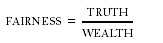
as wealth increases, one's perception of fairness actually increases until it peaks where wealth and need reach equilibrium. Equilibrium is when one has sufficient wealth to obtain the resources necessary to meet fundamental needs. Fundamental needs are typically food, shelter, healthcare, transportation, and possibly education. These are the typical resources essential to maintain reasonable security and happiness. Once we pass the point of equilibrium our perception of fairness decreases because we no longer motivated by a sense of need, but a sense of maintaining or adding to our wealth. Hence we transform from needy to greedy. The following graph illustrates my argument:
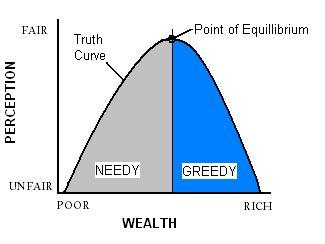
Where one's perception falls above or below the truth curve determines the sense of fairness and the motivation for it. Obviously if one is dellusionally optimistic they will fall above the truth curve regardless of wealth. If one is dellusionally pestimistic they fall below the truth curve regardless of wealth. If one is on the truth curve, then their wealth determines the degree of fairness sensed and the motivation for it.
I find this phenomenon an intriguing one. Some poor people feel they are treated fairly and deserve their station in life, as found in some countries like India. This is evident in the culture of the caste system, which extends to their spiritual beliefs. Further, there are many examples of where the poor felt they were treated unfairly although most of their basic needs were met. Like in more modern societies of North America and Europe where typically socialist societies met those needs. They still felt compelled to strike for more benefits due to perceived unfairness.
On the other end of the spectrum the rich sometimes do not perceive themselves as being greedy although their fortunes sometimes exceed any reasonable need many times over. They sometimes justify this wealth as fruits of their well deserved labor and hard work. I critically question whether they truly work any harder than many people less affluent. Some are obviously wealthy by birth, good fortune and advantagous opportunity, not work. That perception of fairness is not completely accurate.
That said however, it would be just as inaccurate to generalize that one is rich because they work hard or because one is poor they are lazy. Wealth is not a sole product of labor and fairness. Economic fairness is however dependent on one's wealth and power.
There are also rich who, spite their mass fortunes, still perceive the world as unjust and unfair because governments tax their fortunes at a different rate than the less fortunate. I argue that they fall into the greedy arena because they fail to see the justice of forced compassion. They often view the government as meddlesome and taxes unfair. They will always feel they deserve a larger share of profit and diminish their argument to a simplified principle of survival of the fitest as the natural order of things. Often they display shelfish traits in words and behavior, and only offer a pretense of charity when it becomes profitable or theraputic to relieve a guilty conscious. Rarely do they discount their goods or services as an act of good conscious, but only when downward force from competition dictates. Limiting profits is contrary to their nature or desire, the higher the better. Greed may stimulate growth, but it has negative consequences that promote unfair practices. I have been amazed at the number of books and institutions that tout greed as acceptable behavior, some of them which also claim to be Christian based. It is absurd to associate the two.
Unbridled and unregulated growth breeds consumption and poverty. We have seen this in our own recent history. During the 1950's and 1960's when organized labor held corporate greed in check, there was much less poverty and most laborers experienced a higher standard of living with much better healthcare and retirement benefits. Since the decline of these unions in the past four decades, the percentage of the population falling into poverty is on the increase. Yet during both periods of time corporations made profits. Some of today's corperations are even experiencing record profits!
Even though I can not honestly say which period in time is more economically fair, it would appear that when less people live in poverty it is more desirable. Then more people would perceive the world as fair and their would be less tension. As shown by my chart, when one's perception is distorted from the truth it is in tension. When ones view is in extreme tension they are more likely to act accordingly. If one is in truth close to equilibrium but in perception believe they are poor then they are in extreme tension and will most likely act. If one in truth is poor and perceives the world as unfair there is not as much tension because they may perceive themselves as powerless to change it, unlike one that perceives themselves as poor and has the means to change it. Similarly, the rich feel less greed at the extreme end of the spectrum and are less likely to be in tension as those closer to equilibrium.
In closing, it would be ideal to have everyone feel the world is fair and wealth distributed accordingly, but the reality is often far from the truth. The truth is we all feel differently and our perceptions of need change with fair treatment. Many models of economics and government have approached the problem with static solutions to a dynamic problem. Our best model is for government is perhaps the best of our technology. Social systems are not unlike a rocket ship. Its survival is dependent upon its limited resources, applied laws, constant monitoring, and leadership. Without all of the essential elements engineered to make the mission, we will never obtain our destiny. I like to think that our destiny as humankind is economical fairness so we all can share in true freedom, equality, liberty and happiness.
We all therefore are in conflict with each others perceptions since we each often experience the same events differently because of our perceptions. A perfect example is when one shares stories with a sibling about a particular event, but have varying recollections of that specific event. Both were raised in similar enviroments but do not particularlly share similar views.
Our perceptions of truth, justice, morality, righteousness, and fairness are therefore influenced by our experience and education. These are more commonly noted as our biases, which extend to our values and beliefs.
It is at the very least difficult, if not impossible for the affluent to make an accurately honest judgment of the poor. Spite best of intentions and honest efforts this still remains a conflict of perception in most of modern societies.
Humankind has built monuments, eradicated disease, flown through space, created empires, yet we fall short of effectively addressing the needs of the poor. I attribute this failure to the inability to obtain concensus on what constitutes a fair standard of living. Albeit, fairness, may be agreed to be relative to ones perception.
I postulate that one's sense of fairness is a direct relationship to truth, and an inverse relationship to wealth, once basic needs have been met.
as wealth increases, one's perception of fairness actually increases until it peaks where wealth and need reach equilibrium. Equilibrium is when one has sufficient wealth to obtain the resources necessary to meet fundamental needs. Fundamental needs are typically food, shelter, healthcare, transportation, and possibly education. These are the typical resources essential to maintain reasonable security and happiness. Once we pass the point of equilibrium our perception of fairness decreases because we no longer motivated by a sense of need, but a sense of maintaining or adding to our wealth. Hence we transform from needy to greedy. The following graph illustrates my argument:
Where one's perception falls above or below the truth curve determines the sense of fairness and the motivation for it. Obviously if one is dellusionally optimistic they will fall above the truth curve regardless of wealth. If one is dellusionally pestimistic they fall below the truth curve regardless of wealth. If one is on the truth curve, then their wealth determines the degree of fairness sensed and the motivation for it.
I find this phenomenon an intriguing one. Some poor people feel they are treated fairly and deserve their station in life, as found in some countries like India. This is evident in the culture of the caste system, which extends to their spiritual beliefs. Further, there are many examples of where the poor felt they were treated unfairly although most of their basic needs were met. Like in more modern societies of North America and Europe where typically socialist societies met those needs. They still felt compelled to strike for more benefits due to perceived unfairness.
On the other end of the spectrum the rich sometimes do not perceive themselves as being greedy although their fortunes sometimes exceed any reasonable need many times over. They sometimes justify this wealth as fruits of their well deserved labor and hard work. I critically question whether they truly work any harder than many people less affluent. Some are obviously wealthy by birth, good fortune and advantagous opportunity, not work. That perception of fairness is not completely accurate.
That said however, it would be just as inaccurate to generalize that one is rich because they work hard or because one is poor they are lazy. Wealth is not a sole product of labor and fairness. Economic fairness is however dependent on one's wealth and power.
There are also rich who, spite their mass fortunes, still perceive the world as unjust and unfair because governments tax their fortunes at a different rate than the less fortunate. I argue that they fall into the greedy arena because they fail to see the justice of forced compassion. They often view the government as meddlesome and taxes unfair. They will always feel they deserve a larger share of profit and diminish their argument to a simplified principle of survival of the fitest as the natural order of things. Often they display shelfish traits in words and behavior, and only offer a pretense of charity when it becomes profitable or theraputic to relieve a guilty conscious. Rarely do they discount their goods or services as an act of good conscious, but only when downward force from competition dictates. Limiting profits is contrary to their nature or desire, the higher the better. Greed may stimulate growth, but it has negative consequences that promote unfair practices. I have been amazed at the number of books and institutions that tout greed as acceptable behavior, some of them which also claim to be Christian based. It is absurd to associate the two.
Unbridled and unregulated growth breeds consumption and poverty. We have seen this in our own recent history. During the 1950's and 1960's when organized labor held corporate greed in check, there was much less poverty and most laborers experienced a higher standard of living with much better healthcare and retirement benefits. Since the decline of these unions in the past four decades, the percentage of the population falling into poverty is on the increase. Yet during both periods of time corporations made profits. Some of today's corperations are even experiencing record profits!
Even though I can not honestly say which period in time is more economically fair, it would appear that when less people live in poverty it is more desirable. Then more people would perceive the world as fair and their would be less tension. As shown by my chart, when one's perception is distorted from the truth it is in tension. When ones view is in extreme tension they are more likely to act accordingly. If one is in truth close to equilibrium but in perception believe they are poor then they are in extreme tension and will most likely act. If one in truth is poor and perceives the world as unfair there is not as much tension because they may perceive themselves as powerless to change it, unlike one that perceives themselves as poor and has the means to change it. Similarly, the rich feel less greed at the extreme end of the spectrum and are less likely to be in tension as those closer to equilibrium.
In closing, it would be ideal to have everyone feel the world is fair and wealth distributed accordingly, but the reality is often far from the truth. The truth is we all feel differently and our perceptions of need change with fair treatment. Many models of economics and government have approached the problem with static solutions to a dynamic problem. Our best model is for government is perhaps the best of our technology. Social systems are not unlike a rocket ship. Its survival is dependent upon its limited resources, applied laws, constant monitoring, and leadership. Without all of the essential elements engineered to make the mission, we will never obtain our destiny. I like to think that our destiny as humankind is economical fairness so we all can share in true freedom, equality, liberty and happiness.
On Howard Dean
I can respect Howard Dean's passion and exuberance, but question his tactics and ability to articulate the ideals of the Democratic Party. Perhaps it is time to question the direction and leadership of the Democratic Party from a Republican critique. Only then will we meet the challenges of the next campaign year.
I somewhat disagree with Howard's tactics personally. We do need a voice, and a strong one. But we should not lower ourselves to the same idiotic banter that the Republicans and people like Rush Limbaugh have been using, it lacks character. Anyone can make generalizations and use name calling. First off, not all all Republicans are lazy, anymore than all poor people are on welfare because they are lazy. It is just an assinine statement. We should carefully choose our words when our anger subsides. Not let anger dictate our platform. Personally I feel these type of politicians appear stupid and ignorant, and lack the wit and articulate ability to make their point.
With that said, I do believe calling president Bush a liar as Harry Reid has done is qualified because the evidence is overwhelming. He called John Kerry wishy-washy and a flip-flopper during the presidential campaign, but if you compare his actions to his campaign promises he has flipped on several issues. Like tax code reform, homeland security, and the environment, to mention a few.
Personally I liked the language Barrack Obama was speaking during his Senatorial run in Illinois. He was much more moderate in tone and spoke to the values most perceive as Americans. He seemed to remind me of another President long past, John F. Kennedy.
Although I like Hillary Clinton, it appears the Republicans like Hillary too! They seem to be the ones pushing her presidential run. My feeling is that they already have a strategy for her bid and are confident they could beat her. Especially the Christians that believe women do not head the household. We need to be careful about being sucked into the Republican game. We need to take our own direction and address the issues on fact, not fantasy and emotion. Let us concede that the Republicans won on moral issues, and challenge them on what is truly moral! Taking money and opportunity away from the poor and elderly is not my family value. Additionally, what family does the Republican platform represent? How many families actually fit the nuclear family model? Let us not argue the question, let's reframe the question. After all, who was better at answering a question with another question than Jesus himself? As a Christian and a Liberal, I challenge the Right's interpretation of Christianity, and I am not alone!
I somewhat disagree with Howard's tactics personally. We do need a voice, and a strong one. But we should not lower ourselves to the same idiotic banter that the Republicans and people like Rush Limbaugh have been using, it lacks character. Anyone can make generalizations and use name calling. First off, not all all Republicans are lazy, anymore than all poor people are on welfare because they are lazy. It is just an assinine statement. We should carefully choose our words when our anger subsides. Not let anger dictate our platform. Personally I feel these type of politicians appear stupid and ignorant, and lack the wit and articulate ability to make their point.
With that said, I do believe calling president Bush a liar as Harry Reid has done is qualified because the evidence is overwhelming. He called John Kerry wishy-washy and a flip-flopper during the presidential campaign, but if you compare his actions to his campaign promises he has flipped on several issues. Like tax code reform, homeland security, and the environment, to mention a few.
Personally I liked the language Barrack Obama was speaking during his Senatorial run in Illinois. He was much more moderate in tone and spoke to the values most perceive as Americans. He seemed to remind me of another President long past, John F. Kennedy.
Although I like Hillary Clinton, it appears the Republicans like Hillary too! They seem to be the ones pushing her presidential run. My feeling is that they already have a strategy for her bid and are confident they could beat her. Especially the Christians that believe women do not head the household. We need to be careful about being sucked into the Republican game. We need to take our own direction and address the issues on fact, not fantasy and emotion. Let us concede that the Republicans won on moral issues, and challenge them on what is truly moral! Taking money and opportunity away from the poor and elderly is not my family value. Additionally, what family does the Republican platform represent? How many families actually fit the nuclear family model? Let us not argue the question, let's reframe the question. After all, who was better at answering a question with another question than Jesus himself? As a Christian and a Liberal, I challenge the Right's interpretation of Christianity, and I am not alone!
Friday, April 29, 2005
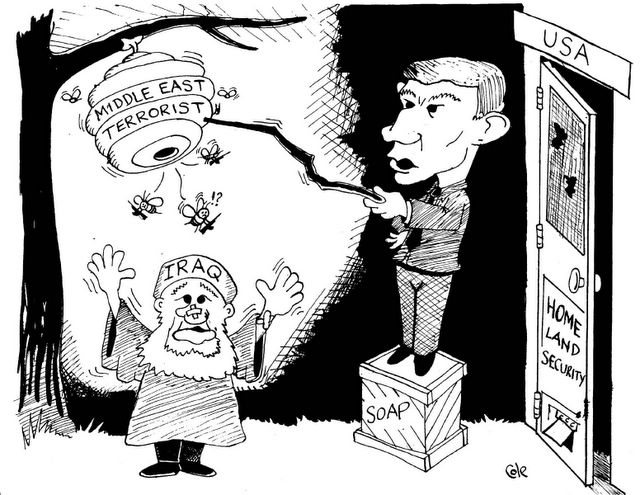

Wednesday, April 27, 2005
Conversations
With all the business of our lives we often take for granted the numerous conversations that transpire throughout the day. Perhaps if I were not alone they would not hold so much significance, but many times they do. When one has no special purpose for existing other than survival and consuming material things there is little to distract them from their thoughts. The true treasures of life however are mostly non-material.
I find that casual conversations are like pools of water in a desert. Each one provides intellectual nourishment. Some may call it small talk, but I find talk very big. Equally stimulating however are the periods of silence. It is not the moments, it is the creative ways in which we use them and whether we appreciate them. The carefully crafted response to someone’s comment or opinion can determine the course of the conversation. Whether it becomes an intense argument or a gracious commentary on the plight of humankind is truly in the way one frames their words. Knowing when to be silent and when to challenge another is an art in itself.
Welcome each day’s encounter with the critical eye of a newborn child. Before forming an opinion and blabbering forth some careless presumption, listen to the complete context of the conversation and offer some delightful tidbit of information, or perhaps a pondering question.
Understandably, not everyone can delight in conversation. Alas, I once suffered the paralyzing affects of introversion. Shy and timid I rarely could engage in social commentary. Yet, I did evolve to a more modest and reserved character that occasionally participated in self-expression.
Today, some may say I am overbearing and opinionated, or even garrulous. To those who are limited in their ability to express themselves that may appear true. Yet, I do not interrupt or dominate the conversation, nor do I act insolent or rude. As far as I can tell, I just enjoy initiating a topic and actively debating an issue. Some are conversationalist, and some are not, the later may find my behavior offensive.
There are many issues at hand to clearly start a conversation, yet there are many times I am at a loss, such as meeting new people for the first time. Whether one debates the current politics, religion, relationships, families, work or daily struggles, many conversations have started with a mere comment on the weather.
Sharing our lives somehow validates our humanity and allows us to keep our perspective. We need to tell a friend of a new movie or purchase. Sometimes we have doubts, or question our reasoning, and need a second opinion.
Often however I bring the same old conversations up when meeting strangers; what do you do? Are you married with children? Why are you here? Where are you from? It sometimes seems trite. Much like taking a familiar road to the park, we make all the same turns and stops, but once we get there, we realize there are many new things to explore.
Yes, I do enjoy my conversations. If not for any other reason than when I finally shut up, I can truly enjoy the silence once again!
I find that casual conversations are like pools of water in a desert. Each one provides intellectual nourishment. Some may call it small talk, but I find talk very big. Equally stimulating however are the periods of silence. It is not the moments, it is the creative ways in which we use them and whether we appreciate them. The carefully crafted response to someone’s comment or opinion can determine the course of the conversation. Whether it becomes an intense argument or a gracious commentary on the plight of humankind is truly in the way one frames their words. Knowing when to be silent and when to challenge another is an art in itself.
Welcome each day’s encounter with the critical eye of a newborn child. Before forming an opinion and blabbering forth some careless presumption, listen to the complete context of the conversation and offer some delightful tidbit of information, or perhaps a pondering question.
Understandably, not everyone can delight in conversation. Alas, I once suffered the paralyzing affects of introversion. Shy and timid I rarely could engage in social commentary. Yet, I did evolve to a more modest and reserved character that occasionally participated in self-expression.
Today, some may say I am overbearing and opinionated, or even garrulous. To those who are limited in their ability to express themselves that may appear true. Yet, I do not interrupt or dominate the conversation, nor do I act insolent or rude. As far as I can tell, I just enjoy initiating a topic and actively debating an issue. Some are conversationalist, and some are not, the later may find my behavior offensive.
There are many issues at hand to clearly start a conversation, yet there are many times I am at a loss, such as meeting new people for the first time. Whether one debates the current politics, religion, relationships, families, work or daily struggles, many conversations have started with a mere comment on the weather.
Sharing our lives somehow validates our humanity and allows us to keep our perspective. We need to tell a friend of a new movie or purchase. Sometimes we have doubts, or question our reasoning, and need a second opinion.
Often however I bring the same old conversations up when meeting strangers; what do you do? Are you married with children? Why are you here? Where are you from? It sometimes seems trite. Much like taking a familiar road to the park, we make all the same turns and stops, but once we get there, we realize there are many new things to explore.
Yes, I do enjoy my conversations. If not for any other reason than when I finally shut up, I can truly enjoy the silence once again!
Subscribe to:
Posts (Atom)